Showing posts with label classics. Show all posts
Thursday, May 5, 2016
Fahrenheit 451 - Ray Bradbury
Fahrenheit 451 is part of the classic dystopian triangle, along with Brave New World and Nineteen Eighty-Four. It was the last of the three to be published, and the last of the three that I read. And I don't QUITE know how to feel about it.
It's the story of Guy Montag, who's a fireman. Except that in this weird, dystopian world, firemen don't come to save you from a fire. No, they come to burn down your house with you inside it. Why? Because you happen to own books. Why burn people who own books? Because books cause unhappiness and conflict in society, and they encourage people to think for themselves.
Except then Guy gets his hands on a book for the first time, and it changes his entire life.
I think my problems with this book was twofold:
1. I reads its 200-odd pages over the course of nine days, rather than reading it in one solid sitting. So from one day to the next, I'd forget a lot of the details of what I'd read and have to decide between backtracking to find out the details or press on regardless and have a few moments of confusion; and
2. It's the kind of book that's great to study in high school, where you have an English teacher pointing out all the symbolism and meaning and major turning points. And because I didn't have that, I finished the book feeling like I was missing something, missing what it is about this book that makes people love it so much.
The ending was pretty action-packed, but the middle was a little...draggy for me. So while I liked it, I'm not entirely sure I understood it. Because sometimes my brain doesn't deal so well with stories that have a lot of layers to them. And this was a prime example of that - the problem here was definitely me and not the book.
Have you read it? What did you think??
K xx
Wednesday, April 20, 2016
Crime and Punishment - Fyodor Dostoevsky
I knew literally nothing about this book when I added it to my Classics Club list. All I knew was that I wanted to read more Russian literature, and that seeing as I've read Tolstoy and Chekov in the past, Dostoevsky seemed like the next logical step.
I had pretty high hopes for this when the back of the copy I borrowed from work described it as something along the lines of "the most accessible novel of all time". It...was not. I should really know by now that the word of academics on the back of Penguin Classics is to be taken with a hefty dose of salt. But no.
This book is the story of Raskolnikov, an indebted student who comes up with a theory that extraordinary people should be outside the law because they add value to society. In order to prove his theory - and counter his money issues - he decides to kill his pawnbroker. Except when he goes to kill her, he finds that her disabled and well loved sister is there too. So he kills her as well. The rest of the book is basically documenting his spiraling guilt and how this changes him.
I really loved the first fifty to one hundred pages of this book. It was tense and a little disturbing, and I was totally on board with it. And I loved the last hundred or so pages, where Raskolnikov's guilt finally drives him to breaking point.
But the 400-odd pages in between? Yeah, that was a little rough. It was slow and - as with my experience of reading Tolstoy - full of lengthy side plots involving characters I didn't really care about. Everyone seemed to have five hundred different names and nicknames, and I struggled - especially when I was only reading 25 or so pages a night - to keep all the characters straight in my head.
So overall, this came out at middle of the road territory for me. I'm glad I read it, and I can see why so many people rave about this book. But I definitely wouldn't describe it as "accessible".
Have you read it? What did you think?
K xx
Wednesday, March 23, 2016
The Picture of Dorian Gray - Oscar Wilde
Oscar Wilde's only novel is a deliciously creepy one, full of the dangers of extreme vanity and always seeking out the beauty in life. My first exposure to this book was approximately a thousand years ago when my little brother's Year 6 teacher(!!!) made it assigned reading for their class. Which, WHAT?!?! Obviously, he couldn't get through it himself, so Mum read it aloud to him and I picked up bits of the story from that.
But I digress.
This is the story of Dorian Gray, a beautiful young man. His friend, Basil Hallward, paints Dorian's portrait and rapidly becomes obsessed with his subject, seeking to spend time with him at every opportunity. But once Dorian meets Basil's popular and somewhat foppish friend, Lord Henry Wolton, who believes that life should be spent pursuing beauty and enjoyment, he becomes equally infatuated and has little time for Basil.
In a moment of weakness, Dorian gives up his soul so that his portrait will grow old and ugly while he remains young and beautiful. What follows is nothing short of scandalous, both for the time of publication and today.
At the beginning of the book, Dorian is basically a blank canvas, easily influenced by those around him. It's his infatuation with Lord Henry's attitudes that ultimately leads him to give away his soul. As time passes and the loss of his soul has more and more of an impact, he becomes a deliciously evil and cold character, almost sociopathic despite having the face of an angel.
It's a book that's full of Wilde's typically beautiful writing, a hefty dose of homoeroticism, and some truly incredible characters. It's not one that I'll read regularly, but it IS one that I'll come back to over the years because it's such an astonishing piece of fiction.
Have you read it? What did you think??
K xx
Wednesday, March 2, 2016
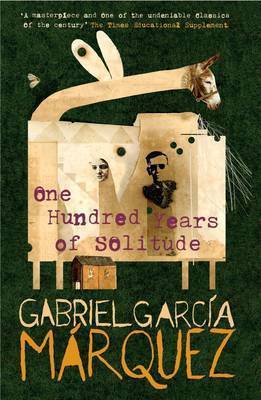
One Hundred Years of Solitude - Gabriel Garcia Marquez

I'm going to be honest, friends: this book was MAJOR struggle bus territory for me. M.A.J.O.R. And really, I should have known that going in. Not long after I first published my Classics Club list, a friend emailed me to warn me about this book, and to emphasise the need to read it in physical form so that you could easily flip to the family tree five million times while reading. And hooooooooo boy, was he right.
This book tells the story of one family living in a small town in rural South America over several generations and one hundred years. It's part epic history, part magical realism, and it's a story told completely without dialogue.
It took me a while to wrap my head around the fact that one minute, it felt like historical fiction and the next, there'd be a plague of insomnia and no one in town would sleep for years, or a character would come back from the dead, or it would rain non-stop for months and yet nothing would flood, or a character would suddenly get blown away with the wind while pegging out the washing. In short, it was bizarre.
But ultimately, the magical realism elements were the least of my problems with this book. The lack of dialogue made it a very slow read for me. And that family tree moved completely invaluable, because every generation of characters has THE EXACT SAME NAMES as the generation before it, and it's impossible to keep track of the characters. Especially when one of the Aurelianos ends up having seventeen sons with seventeen different women, and ALL SEVENTEEN OF THEM are named Aureliano. Seriously.
Add in the fact that it features grown men falling in love with pre-teen girls and waiting for them to reach puberty before insisting on marriage, and aunts ending up in sexual relationships with their nephews, and it really wasn't an easy book to read. Or an enjoyable book a lot of the time.
There's essentially no plot a lot of the time - it's just a long rambling history. And while the writing was often beautiful - and don't get me wrong, there really were some BEAUTIFUL moments - there just wasn't sufficient payoff for me to find this book anything but a struggle.
Have you read it? What did you think??
K xx
Thursday, February 18, 2016
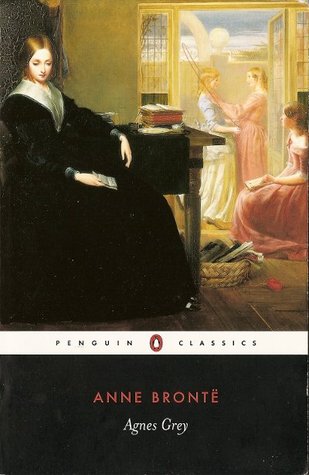
Agnes Grey - Anne Bronte
Agnes Grey, written by Anne, the most overlooked Bronte sister, tells the story of a young woman who decides to become a governess after her father speculates and loses all their money. She works first for a horrible family with horrible children, then for a family with teenage daughters more in need of a companion than a governess. And then she falls in love, because of course she does.
In a lot of ways, this book feels a hell of a lot like Jane Eyre Light. Agnes isn't as passionate or compelling a character as Jane is, and there are - thankfully - far fewer mentally ill wives hidden in the attic. But Agnes is still quiet and loyal to those she loves, exactly like Jane.
It's quite a short book, and at times the story falls flat simply because it IS so short. Certain scenes could easily have been expanded upon to truly bring life to the characters. The writing, while it lacks Charlotte's turn of phrase and Emily's dark passion, is compelling in its own way. And despite being Jane Eyre Light, I found myself invested in Agnes' story and wanted her to get a happy ending.
So despite the inevitable comparisons to its more well known cousin, Agnes Grey is definitely worth the read, if only to the experience of reading all three Bronte sisters.
Have you read it? What did you think??
K xx
Wednesday, January 13, 2016
The Diary of Anne Frank - Anne Frank
I first read this book, as so many of us did, in my early teens. And at the time, I don't think I really appreciated just how significant a document it actually is. So I'm incredibly glad that I chose to reread this book as part of my Classics Club project.
It's always hard to review published diaries, because no matter how well-known they are, the fact remains: the author never intended them to be read by anyone other than themselves. Diaries are a place to dump the emotions you can't discuss with anyone, the thoughts you need to just get out so they're no longer floating around in your brain. Especially when you're a 14 year old girl.
So you'll find hundreds of reviewers out there complaining about how whiny and annoying this book is. Which, in some ways, I understand. Anne's a 14 year old girl. And to some extent, ALL 14 year old girls are whiny and annoying.
But I'd like to see any of those reviewers trapped in a tiny apartment with seven other people for YEARS, constantly fearing for your life, not knowing whether you'd be caught or blown up in an air raid, or starve to death if something happened to the people who were protecting you. I'd like to see those people go through what Anne Frank went through, and still retain the amount of optimism that flows through her writing. Because it really is astonishing.
It's not always an easy book to read. But it is a hugely significant one, capturing not only what life was like for Jewish people in Holland during the early stages of the war, and just how quickly things changed, but in capturing very clearly what life was like for one small group in hiding, and the lengths that people were willing to go to in order to keep them safe.
So yes, Anne was an occasionally whiny and annoying 14 year old girl. But considering that she was a 14 year old girl writing a diary? Her writing was often poignant and astonishing, and this book should remain a must read for everyone.
Have you read it? What did you think??
K xx
Monday, January 4, 2016
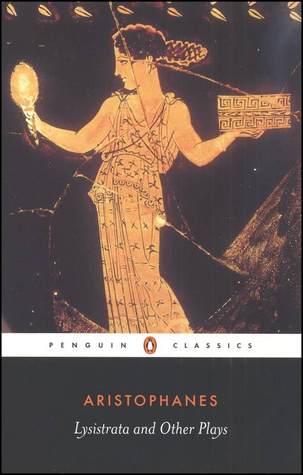
Lysistrata and Other Plays - Aristophanes
I first heard of Aristophanes at some point in high school, while studying something cheerful like Antigone or Medea during VCE. And in comparison, Greek comedy sounded like a hell of a lot of fun, which is why I figured I may as well add some to my Classics Club list, especially after hearing Lysistrata referred to as essentially a feminist story.
This collection started with The Achanians, which is essentially arguing for peace during a long war with Sparta. Next came The Clouds, which basically takes the piss out of the Greek philosophers. And finally, I came to Lysistrata, which features the women of the various Greek city states deciding that the quickest way to end a war is to withhold sex.
Of the three, I think The Achanians may have been my favourite. All three featured a hell of a lot of dick jokes, but The Achanians also involved a lot of poking fun at the other city states, which was still pretty damned funny thousands of years later. That said, Lysistrata is definitely a rare classic in that it's very female dominated and revolves around women having agency over their bodies, so it was definitely a pretty great read as well.
I had a few issues with the translation in this one. Obviously, a lot of the humour wouldn't translate well to modern English - thankfully, Penguin always provide plenty of footnotes on that front! - but Alan H. Sommerstein made the decision to make the Spartans have stereotypical Scottish accents and mannerisms, and the Corinthians have stereotypical Irish accents and mannerisms. Which DID work moderately well - it gave a sense of how the Athenians felt about each of their neighbouring city states. But at the same time, it was totally bizarre to have characters with Scottish accents talking about Zeus and Athena and Poseidon.
On the whole, this collection was funnier than I was anticipating - I thought it would be more like Shakespeare's comedies, where they're hilarious in person but on the page, they tend to be pretty dry, so I was pleasantly surprised to find myself laughing out loud while reading it, and I'm definitely glad I put it on my Classics Club list!
Have you read it? What did you think??
K xx
Friday, December 11, 2015
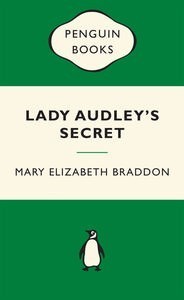
Lady Audley's Secret - Mary Elizabeth Braddon
![]() |
I remember at the time thinking that it didn't really compare to Collins' writing, and I was probably right. Mary Elizabeth Braddon isn't QUITE in the same class as Wilkie Collins. But despite being the lesser writer of the two, she still manages to spin one HELL of a story.
Lady Audley's Secret revolves around Robert Audley, a young barrister. Accompanied by his friend George, he pays a visit to his uncle, who's recently married a much younger woman. When George disappears mysteriously shortly thereafter - with a trail of clues leading to suggest that he may have returned to the Australian goldfields - Robert gets it into his head that his new aunt is involved.
So he takes it upon himself to start investigating Lady Audley's past. He rapidly discovers that things don't entirely add up, especially when he takes into consideration the circumstances of George's disappearance and the fact that George left without leaving any plans in place for his young son. As the story progresses, Robert finds himself in an increasingly dangerous quest for the truth.
I really enjoyed this book. It was definitely a page turner as far as I was concerned, full of great characters and exciting adventures. Sure, Lady Audley's secret turns out to be a little bit of an anticlimax. But Lady Audley herself is a fabulous and incredibly conniving character, who'd probably be classified as a sociopath in the modern world. And I honestly can't work out if I think her fate was well deserved or not.
On the whole, it was a very enjoyable and occasionally creepy mystery, and I'd definitely recommend checking it out, especially if you like Wilkie Collins' writing.
Have you read it? What did you think??
K xx
Monday, November 30, 2015
Brave New World - Aldous Huxley
This book was part of a very long list of suggested reading that my English teacher handed out when I was in Year 10. Obviously, given that "dystopian" wasn't really a genre in 1998, my teacher told us that it was a classic sci-fi story, and I immediately dismissed it as too boring to read because sci-fi novels meant spaceships, and that meant snoozeville.
Oh, fifteen year old Kirsti. How foolish you were.
In a lot of ways, it's not surprising that this book ends up on banned books lists as often as it does. The dystopian society that Huxley created is a fairly disturbing one. Humans are grown in laboratories, and their social status determined before they're even created. Those doomed to be menial Epsilons are cloned dozens of times and bred to be stupid and unquestioning, living only for the drugs provided to them by the government. Meanwhile, the Alphas and Betas receive hours of subliminal messages as children about how much better it is being their caste.
All children are encouraged to participate in "erotic play", which creeped me out more than a little bit, and the whole society has a very casual attitude to sex. Relationships are discouraged in favour of a string of hook ups with people at your own level in society, and the whole world is basically a capitalist's dream.
The "real" world - where people form relationships, have children, and grow old - is confined to reservations for Indigenous populations, and these reservations are treated almost like a zoo by the Alphas and Betas. And yet it's the "noble savage" character who shows the most signs of what readers at the time of publication would consider a civilised attitude. He quotes Shakespeare, is disgusted by the decadence and throw-away attitude of the "civilised" world, and wants nothing more than a monogamous relationship and to know his father.
It's a disturbing book a lot of the time, and the ending was particularly chilling. Basically, I was expecting to be bored by this, but I found it the complete opposite.
Have you read it? What did you think??
K xx
Friday, November 20, 2015
The Catcher in the Rye - J.D. Salinger
This book has been on my radar for years. I think the first time I heard about it was that Mel Gibson and Julia Roberts movie, Conspiracy Theory, in which Gibson's character can't calm down unless he has a copy of it, and in which the government apparently uses library patron histories to identify serial killers based on who borrows The Catcher in the Rye. Or something?? I haven't seen that movie in years, so I may be wrong.
Anyway, I put off reading this book for YEARS because a tiny part of my brain was convinced that if I borrowed it from my local library, I'd be flagged as a serial killer. But basically, all I knew about the book was that the main character is called Holden Caulfield, and it's J.D. Salinger's only novel.
And I kind of wish I'd left it that way. I was on the struggle bus with this book essentially from the get go. The opening few chapters - the stuff before Holden leaves school - reminded me a lot of Dead Poets Society, and more specifically Charlie. Seeing as Dead Poets Society is one of my favourite movies, I was moderately interested in the story.
But then Holden left school, and things went rapidly downhill. We're trapped in Holden's head for endless pages with few other characters to break things up. And this was hard for me, because I didn't like Holden AT ALL. He's full of rich white boy problems, where everything is someone else's fault. Holden always thinks he's in the right, despite however much evidence is stacked up against him. Essentially, I couldn't stand him or the narrative style.
I REALLY didn't like the writing. Admittedly, it's a product of the time. It's set in the late 1940s and is told by a teenage boy, so the amount of misogyny that comes through in the story is almost to be expected. But the amount of repetition in the writing drove me up the wall. Holden will make an observation about another character, then insert an anecdote about that character doing the thing he observed them doing, then repeat his observation. Like, "The girl could dance. [Insert long winded anecdote about said girl dancing here] I tell you, the girl could dance."
YES. WE KNOW. YOU LITERALLY JUST TOLD US.
By the end of the book, I just flat out didn't care, and when it featured a total non-ending on top of all the repetition and angst and misogyny that I'd already had to wade through, I was tempted to throw the book across the room.
I feel like this is a book that's more enjoyable if a) you study it in school and can unpackage all the things that Salinger is trying to say, or b) you're an angsty teenager when you read it. So maybe if I'd read this as a teenager, I'd see the appeal. But as an adult? NOPE.
On the plus side, this book marks the half way point for my Classics Club project!
Have you read it? What did you think?
K xx
Thursday, November 5, 2015
The Chrysalids - John Wyndham
Remember when I used to review my Classics Club books in a timely fashion? Yeah. Me too...
I'd reread The Day of the Triffids just prior to creating my Classics Club list last year, and I absolutely adored it. So it made perfect sense to put another John Wyndham book on my list. Last month, I finally got around to reading it. (But not reviewing it. Because I'm the worst.)
The Chrysalids is a dystopian novel, pure and simple. Set a thousand years in the future, it tells the story of a group of young people living in an isolated community on the island of Labrador. The mainland, we're told, is a wasteland and the community prides itself on weeding out any genetic mutations, whether they be in plants, animals or humans.
As a child, the protagonist, David, witnesses a friend and her family being cast out into the wilds because said friend has six toes on one foot. This makes him uncertain about the way he's been raised, and when he and a group of other children develop telepathic abilities, they try to keep things quiet for as long as possible.
At its heart, this is very much a Cold War novel. It plays on the fear of the 'other' that was so prevalent in the 1950s, as well as including a nuclear apocalypse. It focuses on the destructive nature of Western society and its futile attempts at perfection.
One of the things I liked best about this book is when the characters find out about Zealand, a technologically advanced Utopia far across the sea to the south. And the reason I liked this so much is simple: so much of the time, dystopian novels are very US-centric, and I always find myself wondering if the rest of the world is in the same predicament or if they're all fine and just watching the chaos unfold. Here, clearly, it's the latter. So I loved that recognition that the rest of the world still exists.
On the whole, this was a short but important story, and it's definitely one I'll reread in the future.
Have you read it? What did you think?
K xx
I'd reread The Day of the Triffids just prior to creating my Classics Club list last year, and I absolutely adored it. So it made perfect sense to put another John Wyndham book on my list. Last month, I finally got around to reading it. (But not reviewing it. Because I'm the worst.)
The Chrysalids is a dystopian novel, pure and simple. Set a thousand years in the future, it tells the story of a group of young people living in an isolated community on the island of Labrador. The mainland, we're told, is a wasteland and the community prides itself on weeding out any genetic mutations, whether they be in plants, animals or humans.
As a child, the protagonist, David, witnesses a friend and her family being cast out into the wilds because said friend has six toes on one foot. This makes him uncertain about the way he's been raised, and when he and a group of other children develop telepathic abilities, they try to keep things quiet for as long as possible.
At its heart, this is very much a Cold War novel. It plays on the fear of the 'other' that was so prevalent in the 1950s, as well as including a nuclear apocalypse. It focuses on the destructive nature of Western society and its futile attempts at perfection.
One of the things I liked best about this book is when the characters find out about Zealand, a technologically advanced Utopia far across the sea to the south. And the reason I liked this so much is simple: so much of the time, dystopian novels are very US-centric, and I always find myself wondering if the rest of the world is in the same predicament or if they're all fine and just watching the chaos unfold. Here, clearly, it's the latter. So I loved that recognition that the rest of the world still exists.
On the whole, this was a short but important story, and it's definitely one I'll reread in the future.
Have you read it? What did you think?
K xx
Friday, October 9, 2015
Madame Bovary - Gustave Flaubert
I was a little hesitant going into this book. I knew almost nothing about it, except for the ending and the fact that a lot of people find it dense and unreadable. So imagine my surprise when I found it a surprisingly easy and compelling read.
Madame Bovary tells the story of farmgirl Emma, who marries provincial doctor, Charles Bovary, and almost immediately regrets it when she realises that it means she has to live in the provinces. She uses books as a means of escapism until her mother-in-law decides that all this fiction reading is making her hysterical, and orders Charles to cut off her access to books. So Emma turns to affairs instead.
I don't know if it was the translation I read or if I was just in the right headspace for this book, but I flew through it. The writing was beautiful, the story was pretty fast paced for a classic, and the characters felt surprisingly modern a lot of the time. Sure, Emma's occasional bouts of full blown hysteria weren't exactly modern, but it's a nineteenth century book. We can't expect everything.
While I was reading this, I was struck several times by similarities to Anna Karenina. Or at least the Anna-y parts of Anna Karenina. Unhappy marriage, one child, affairs, tragic ending. Except that I liked this approximately a thousand times more than Anna Karenina, with all its rambling side plots and segues about farming.
The ending was both more and less dramatic than I'd imagined, and while I'm not entirely sure how I feel about the "whip around all the main characters to find out their fates" chunk at the very end - because it seemed a little anticlimactic after the drama that preceded it - I still appreciate that it was included to demonstrate the impact that certain events had on those involved.
On the whole, I thoroughly enjoyed this book and I'd definitely recommend it.
Have you read it? What did you think??
K xx
Wednesday, September 30, 2015
My Brilliant Career - Miles Franklin
Oh, hi. Remember when I used to do this blogging thing? Yeah, me too...
I actually finished this one about three weeks ago, and just kept on forgetting to actually review it. Whoops.
So. My Brilliant Career. It's the story of Sybylla, a teenage girl growing up in rural Australia in the 1890s. Her father makes bad decisions and ends up dirt poor. The family try to scrounge a living together, but the drought hits and all the animals start dying. So Sybylla's reasonably rich grandmother takes her off her parents' hands with the hopes of marrying her off or turning her into a governess. But Sybylla wants to do something more with her life, and starts writing about her life.
Sybylla was a FABULOUS character. She's sassy and fiercely independent and often talks in all caps. She'd rather hang out with the shearers and the grooms than with people of her own class. In short, she feels like a teenager struggling her way through a world where she's expected to be an adult already.
It's full of incredible characters and funny moments and amazing writing.
But then I hit My Career Goes Bung. And...it was not good. The basic gist of it is that everything we knew in My Brilliant Career was what Sybylla had written. In My Career Goes Bung, she tells us that huge parts of My Brilliant Career were fictional. There was no Harold Beecham. She had no siblings. Her mother and grandmother were both vastly different characters.
So basically? We had to get to know Sybylla all over again. And I didn't like Writer Sybylla nearly as much as the character she'd apparently created. Especially when she was dumped into an all-new environment with all-new characters.
In summary, I gave the omnibus book 4 stars, but it was more like 4.5 stars for My Brilliant Career and 3 stars for My Career Goes Bung.
Have you read this? What did you think?
K xx
I actually finished this one about three weeks ago, and just kept on forgetting to actually review it. Whoops.
So. My Brilliant Career. It's the story of Sybylla, a teenage girl growing up in rural Australia in the 1890s. Her father makes bad decisions and ends up dirt poor. The family try to scrounge a living together, but the drought hits and all the animals start dying. So Sybylla's reasonably rich grandmother takes her off her parents' hands with the hopes of marrying her off or turning her into a governess. But Sybylla wants to do something more with her life, and starts writing about her life.
Sybylla was a FABULOUS character. She's sassy and fiercely independent and often talks in all caps. She'd rather hang out with the shearers and the grooms than with people of her own class. In short, she feels like a teenager struggling her way through a world where she's expected to be an adult already.
It's full of incredible characters and funny moments and amazing writing.
But then I hit My Career Goes Bung. And...it was not good. The basic gist of it is that everything we knew in My Brilliant Career was what Sybylla had written. In My Career Goes Bung, she tells us that huge parts of My Brilliant Career were fictional. There was no Harold Beecham. She had no siblings. Her mother and grandmother were both vastly different characters.
So basically? We had to get to know Sybylla all over again. And I didn't like Writer Sybylla nearly as much as the character she'd apparently created. Especially when she was dumped into an all-new environment with all-new characters.
In summary, I gave the omnibus book 4 stars, but it was more like 4.5 stars for My Brilliant Career and 3 stars for My Career Goes Bung.
Have you read this? What did you think?
K xx
Thursday, August 27, 2015
Middlemarch - George Eliot
I have a confession to make: I got this book as a present for my seventeenth birthday. It's taken me fifteen years to get around to reading it. Why? Because I had to read The Mill on the Floss for first year university fourteen years ago, and it was non-stop struggle street for me. Essentially, it put me off reading George Eliot for a really long time.
So when I was putting together my Classics Club list, I figured I may as well put this one on the list and see if I could get over my preconceived notions about George Eliot.
I...had mixed feelings about this book. It's essentially the story of a town's worth of inhabitants. The story starts with one or two major characters, then moves on to focus on a couple of characters who appeared as minor characters in the previous section etc etc.
As a general rule, I struggle with stories that jump around between a lot of characters. I had the same feelings about Cranford by Elizabeth Gaskell, and Shirley by Charlotte Bronte. Hell, I even felt that way about Game of Thrones. And it's not because any of those books were bad (although personally, I thought Game of Thrones was decidedly mediocre). It's just that they jumped around so much that I found it difficult to keep all the different threads of the story straight in my head, and I struggled with the sections dealing with characters that I didn't especially care for.
What I liked most about Middlemarch was that the characters weren't perfect. And I'm not talking flawed in the way that Elizabeth Bennet and Fitzwilliam Darcy are flawed where you can't help but love them. In Middlemarch, the characters are deeply flawed. They don't always get happily ever afters. They rush into marriage and then discover that their new spouse isn't the person they thought. They stand back and let people die. They hold grudges, they screw up, they're vindictive, they're petty.
And all of that was great. They were actual human characters leading actual human lives. But there were a lot of characters that I just didn't particularly care about. Either I didn't find them interesting or their stories dragged on and on without any real progress for hundreds of pages, and then all of a sudden things would be wrapped up in a neat little package with two pages to spare.
Really, I think the problem here was me more than the book. It was long and often dry, and there were times when I felt like I was reading page after page without making any real progress. The characters that I liked were enough to get this a three star rating from me. But I definitely didn't have the five star "OMG AMAZING" experience that so many others seem to have had. Which, frankly, makes me a little bit sad.
Have you read it? What did you think?
K xx
Friday, August 14, 2015
Bout of Books goals
The Bout of Books read-a-thon is organized by Amanda @ On a Book Bender and Kelly @ Reading the Paranormal. It is a week long read-a-thon that begins 12:01am Monday, August 17th and runs through Sunday, August 23rd in whatever time zone you are in. Bout of Books is low-pressure. There are challenges, giveaways, and a grand prize, but all of these are completely optional. For all Bout of Books 14 information and updates, be sure to visit the Bout of Books blog. - From the Bout of Books team
So. Bout of Books 14 starts on Monday, and as such I figured it was probably about time that I talked about my goals for the week ahead. I'm not setting myself a certain number of books or a certain page count per day this time around, so my goals are pretty simple.
1. Finish MiddlemarchI've been reading Middlemarch since 21 July, and while I've been making steady progress (I'm currently just past page 600) I'm really very ready to be done with it. So I'm making it one of my goals to get through the last 200-ish pages next week.
2. Participate in a challenge
This was one of my goals last time, and I failed spectacularly due to an unusually busy week. This time around? I'm determined to do better.
3. Only pick up rereads
Look, this one is partly in place because I really want to reread all four of the Throne of Glass books before Queen of Shadows comes out on 1 September. But it's also because I don't really feel like I'm doing new books justice if I race through them during a readathon. So, with the exception of finishing off Middlemarch, I'm aiming for a reread-only event!
That's it for me this time around. Pretty simple goals, I know, but considering I don't have a whole lot of free time these days - especially seeing as we're smack bang in the middle of VEDA - I didn't want to set a bunch of targets and then find myself unable to achieve them. Hell, even if the only one I achieve is finishing Middlemarch? I'm going to be calling it a success.
Are you participating in Bout of Books?
K xx
So. Bout of Books 14 starts on Monday, and as such I figured it was probably about time that I talked about my goals for the week ahead. I'm not setting myself a certain number of books or a certain page count per day this time around, so my goals are pretty simple.
1. Finish MiddlemarchI've been reading Middlemarch since 21 July, and while I've been making steady progress (I'm currently just past page 600) I'm really very ready to be done with it. So I'm making it one of my goals to get through the last 200-ish pages next week.
2. Participate in a challenge
This was one of my goals last time, and I failed spectacularly due to an unusually busy week. This time around? I'm determined to do better.
3. Only pick up rereads
Look, this one is partly in place because I really want to reread all four of the Throne of Glass books before Queen of Shadows comes out on 1 September. But it's also because I don't really feel like I'm doing new books justice if I race through them during a readathon. So, with the exception of finishing off Middlemarch, I'm aiming for a reread-only event!
That's it for me this time around. Pretty simple goals, I know, but considering I don't have a whole lot of free time these days - especially seeing as we're smack bang in the middle of VEDA - I didn't want to set a bunch of targets and then find myself unable to achieve them. Hell, even if the only one I achieve is finishing Middlemarch? I'm going to be calling it a success.
Are you participating in Bout of Books?
K xx
Thursday, July 23, 2015
A Tale of Two Cities - Charles Dickens
Yes, I'm aware that this cover is hideous. But after discovering that ALL THREE copies we have of this at work are abridged, I had to resort to the free Kindle version...
My first exposure to this book came at the age of ten or eleven. Somehow, I got my grubby little hands on a Dickens omnibus, and I slogged my way through A Christmas Carol, Great Expectations, and half of this before I left it at a friend's house in England, only to be reclaimed four years later.
So when it came time to assemble my Classics Club list, it seemed appropriate that I should put this on there. And for the most part, I found it enjoyable if not especially Dickensian.
Set during the French Revolution, A Tale of Two Cities is a lot more serious than the other Dickens books I've read. Which isn't to say that other Dickens books aren't serious. Many of them are! But there's usually SOME element of comic relief to the story, one or two utterly ridiculous characters who provide the reader with a few moments to come up for air before diving back into the depths of opium addiction or child abuse or debtors prison or traipsing barefoot across the moors in fifteen feet of snow or whatever other horrors Dickens put his characters through.
Dickens apparently considered this his best work, and while I'm not entirely convinced I agree, it's definitely a fabulously written book that tells a compelling story. Admittedly, it took me a while to get into things, but once I did, it was full steam ahead.
I think what's most fascinating to me where A Tale of Two Cities is concerned is that it's historical fiction. There's a great tendency, I think, to consider historical fiction a product of the twentieth century. But here, Dickens is writing about events that happened some 80-odd years earlier. This is the French Revolution seen through nineteenth century eyes. This is, in effect, the French Revolution as we view the World Wars today. And that gave me a new appreciation for the story.
Having studied the French Revolution in high school, the story made far more sense to me this time than it did at the age of 10. (Shocker, right??) The villains are spectacularly villainy. The heroes are long suffering and make sacrifices to save those they love. It's a story almost entirely free of side plots, which must have just about killed Dickens to do, because the man really does love a good side plot (not to be confused with Victor Hugo, who loved a good 100 page tangent). And it's a story full of some of the most amazing quotes to come out of nineteenth century literature.
In short, I thoroughly enjoyed it.
Have you read it? What did you think?
K xx
Monday, July 13, 2015
Virgil - The Aeneid
Another book crossed off my Classics Club list, and this one was another CLASSIC classic. I'd heard a lot of amazing things about this book, most of them from my little brother, who did Latin all through high school and is still a big fan of Greek and Roman literature.
First things first: this is basically fan fiction. Virgil wrote it at a time when Rome was in upheaval, and this legitimises not only the origins of Rome, but the reign of Julius Caesar and, by extension, Augustus who was emperor at the time Virgil was writing. So yeah. It's basically rewriting Roman history to authenticate it and give it a basis in the existing history of the classical world as it was known at the time.
In The Aeneid, Virgil takes a minor character from The Iliad whose fate is ambiguous. He has him lead a party of Trojans away from Troy as it falls, and they travel across the Aegean and around Sicily to Carthage before heading up into Italy and fighting a series of wars to claim their homeland and found Rome. Virgil died before finishing the poem, so it finishes in the middle of a series of wars, prior to the founding of Rome.
I...had mixed feelings about this. I really loved the initial books, the story of Aeneas and his family trying to get out of Troy, the story of the Trojan horse, the story of their flight across the Aegean to Carthage. All of that was really compelling stuff, and I thoroughly enjoyed it. I even enjoyed the slightly weird sixth book where Aeneas visits the Underworld and his dead father gives him a prophecy about Rome's future.
But then the second half of the story is battle after battle after battle. We get introduced to character after character just before they die in horribly graphic ways, interspersed with discussions from the gods about what's going on and debates about who should marry who to end the wars. And uuuuuuuugh.
Honestly, it doesn't surprise me that I felt this way. The first half of the story follows the style of The Odyssey, which I very much enjoyed. The second half is more like The Iliad, which I found to be kiiiiiind of a repetitive snorefest.
I ended up giving The Aeneid three stars. Like I said, I very much enjoyed the beginning of it but by the end? I kind of just wanted it to be over. And then it ended all too abruptly. Sigh.
Have you read it? What did you think??
K xx
Monday, June 29, 2015
Vanity Fair - William Makepeace Thackeray
![]() |
| Totally not the edition I read. Mine doesn't even have an ISBN because it's from like 1965. |
At some point, I studied it?? I'm not sure if it was for Literature in year 11 or 12, or if it was first year university. Honestly, the only reason I remember that I studied it is because my copy (which is technically my mum's copy) still has some of my incredibly helpful notes in it:
I've read the book three or four times now, and I love it a little bit more every time I read it. Becky is a fabulous anti-heroine. Despite being incredibly manipulative and conniving and out to get whatever she can for herself, she somehow manages to be almost likeable and you find yourself appreciating the somewhat insane lengths that she'll go to. That said, the way she treats her son is fairly horrific, and it's understandable that a lot of people find that unforgivable.
The story that would traditionally be the centre of any classic novel - that of Emmy and Dobbin - is, in Thackeray's hands, somewhat foolish. Dobbin spends fifteen years pining away over his dead best friend's widow, rushing from India to England when a letter from his sister says that Emmy might marry someone else. And yet, it still takes another three years for anything to happen.
Emmy, similarly, is portrayed as simpering and ridiculous, seeing George as an angel, a martyr in Heaven. She prays before his picture every night, when in reality George was a philandering, gambling scumbag who only thought of himself and only married Emmy because Dobbin pushed him into it.
Thackeray is incredibly cynical and sarcastic throughout, with the authorial voice cutting into the story time and time again. And it's BRILLIANT. He mocks society throughout the whole eight hundred odd pages, He mocks the elite and how easily they fall from grace. He mocks polite society for refusing to see what's right in front of its face. He mocks poor Jos Sedley from start to finish. He mocks practically every character he created, and I loved every single second of it.
It's definitely one of my favourite classic novels, and I'm incredibly glad I took the time to reread it. Now if you'll excuse me, I'm off to rewatch the mini-series.
Have you read it? What did you think??
K xx
Monday, June 8, 2015
The Scarlet Letter - Nathaniel Hawthorne
I read the free Kindle edition, not the Penguin one but the cover on the Kindle edition is boring. So.
Literally all I knew about this book going in was that it's set in a Puritan community, and that there's a movie version starring Demi Moore. Oh, and it led to the creation of Easy A, something I will forever be grateful for.
It's a really short book and a surprisingly easy read, given all the "thou"-ing and "doth"-ing. It tells the story of Hester Prynne, a widow in a Puritan town who falls pregnant and refuses to say who the father of her child is. As a result, the super judgey townsfolk make her wear a red "A" on her dress at all time, indicating that she's an adulterer.
Hester goes and lives outside the town with her child, Pearl, and continues to be judged over the years. As the story progresses, it becomes obvious who the father of her child is, and that he's eaten up with guilt about the fact that she's being punished while he walks around town without judgement and without comment. And eventually, his guilt leads him to speak to Hester and confess to the townspeople.
This book was...fine. I'm not convinced it's quite worthy of the praise that's continually heaped upon it, but it's fine. I think it's probably one of those classic books that's easy to read but hard to deal with in the twenty-first century because so much of the story is essentially caught up in slut shaming.
Hester, on the surface, doesn't seem like a particularly strong female character. I mean, she goes and lives in the woods for seven years, still wearing the "A" on her dress at all times. But she never complains, she never cowers away from her punishment. While she doesn't deserve the treatment that she receives, she's strong enough to take it without flinching because that's what her child needs. In contrast, Pearl's father is eaten away by his sin and the guilt he has over keeping silent for so long.
Speaking of Pearl, I found her a little on the creepy side. She's often referred to in the book as "elfish" or "impish". Mostly I thought she was slightly disturbing. She's essentially the personification of sin, but given all the talk of devils and demons that goes on, pretty much all I could think of was all the creepy little girls that have featured in Supernatural over the years and how Pearl would fit in with them very nicely...
I'm not sure it's a book I'd reread in a hurry. But I'm still glad I read it for myself.
Have you read it? What did you think??
K xx
Friday, May 22, 2015
Emma - Jane Austen
![]() |
| Totally not the edition that I read, but OH WELL. |
I can't even pinpoint exactly what it is about Emma that makes me dislike her so much. She means well, yes, but that doesn't fix the fact that she's often condescending and snobbish. She's so bored by her own life that she feels the need to meddle in the lives of others, with potentially disastrous circumstances. She pushes Harriet towards Mr. Elton, who's obviously never going to marry the daughter of nobody-in-particular, she's generally awful to Miss Bates, and she behaves horrifically towards Jane Fairfax time and time again.
Admittedly, she's not the only guilty party where this last one is concerned. Frank Churchill is equally abhorrent to me. I mean, DUDE. You're madly in love with Jane, but you're badmouthing her to Emma whenever all three of you are in the same room to hide the fact that you're madly in love? What the hell?! Nothing about that is okay.
Look, don't get me wrong. It's full of humour and wit - I think my favourite line that I came across was this: "Emma's very good opinion of Frank Churchill was a little shaken the following day, by hearing that he was gone off to London, merely to have his hair cut." It's utterly ridiculous and reminds the reader that if Frank Churchill lived in the twenty first century, he'd be an obnoxious hipster who trekked half way across the city on his fixed gear bike to get a bag of that stupid coffee that's been pooped out by a civet.
At the end of the day, it's Austen. And that means fabulous writing and fun characters and a happily ever after. But when I didn't like Emma herself, and I found Mr Knightly as interesting as watching paint dry, this book was never really going to be a hit with me...
Maybe I'll reread it AGAIN in a couple of years and find a new appreciation for it. But given that my meh-tastic feelings about this book have been around for nearly 20 years, I'm not so sure. Maybe I'll just stick to watching Clueless...
Have you read Emma? What did you think?
K xx
Subscribe to:
Posts (Atom)


